• Skip to main content
SIGN UP
  • News
  • FAQ
  • 2025 Replay
  • Shop
  • Donate
SIGN UP

Dominican Rosary Pilgrimage

A National Pilgrimage Devoted to Christ and Our Lady

  • News
  • FAQ
  • 2025 Replay
  • Shop
  • Donate

Dominican Friars

May 23 2023

Living Our Lady’s Graces

Those who pray the Rosary with all their heart know from experience that the Rosary is an “outpouring of love” (St. Pope John Paul II, Rosarium Virginis Mariae). What evokes love in us like nothing else is the face of the beloved gazing at us. The Rosary intends to be just that.

“The Rosary is one of the traditional paths of Christian prayer directed to the contemplation of Christ’s face.” In fact, if we did not have the gift of the Rosary in our life, we would search for a way to fix on Christ’s face. In God’s divine providence we do not need to invent this way, for “with the Rosary, the Christian people sits at the school of Mary and is led to contemplate the beauty on the face of Christ and to experience the depths of his love… To recite the Rosary is nothing other than to contemplate with Mary the face of Christ.”

The love poured out to us in the Rosary orients us to both heaven and earth. For in contemplating Christ’s face in the rosary, “we become open to receiving the mystery of Trinitarian life,” while at the same time “the Rosary leads to an encounter with Christ in his mysteries and so cannot fail to draw attention to the face of Christ in others, especially in the most afflicted.” And since “no one has ever devoted himself to the contemplation of the face of Christ as faithfully as Mary,” Our Lady’s role in our contemplating of Christ’s face remains vital.

Pope John Paul II revered the Rosary as “an echo of the prayer of Mary, her perennial Magnificat for the work of the redemptive Incarnation which began in her virginal womb.” What could be better than to be caught up in our Lady’s “perennial Magnificat”?  For here is the fact: “Never as in the Rosary do the life of Jesus and that of Mary appear so deeply joined.”

– Fr. Peter John Cameron, O.P.
An excerpt from the book Mysteries oft he Virgin Mary: Living Our Lady’s Graces


Fr. Peter John Cameron, O.P., grew up in Vernon, Connecticut. He was ordained a Dominican priest in 1986. He holds a Licentiate in Sacred Theology from the Dominican House of Studies, and a Master of Fine Arts in playwriting from the Catholic University of America. He is an award-winning playwright, and the founder and artistic director of Blackfriars Repertory Theatre in New York City. Since 1994, Fr. Peter John has taught homiletics at various seminaries, and he now teaches at the Josephinum.

He is the author of ten books, including The Classics of Catholic Spirituality, Blessing Prayers, Mysteries of the Virgin Mary, Made for Love—Loved by God, Novenas for the Church Year, Jesus Present Before Me, and Why Preach: Encountering Christ in God’s Word. He served two terms as the director of preaching for his Dominican province. Fr. Peter John is the founding editor-in-chief of Magnificat, where he worked from 1998-2018. He is the Prior (the local superior) of St. Patrick Priory.

Written by Dominican Friars · Categorized: Uncategorized

May 18 2023

7 Reasons to Return to Confession in Easter

Lent is a great time for Catholics to return to Confession, but it would be wrong to think that Easter is not. In fact, with a little reflection, we can find many reasons why Easter is a particularly graced time to go to Confession, even after a lackluster Lent. As a start, I propose seven reasons.

  1. Confession is Christ’s Easter gift to the Church.

On the first Easter Sunday, the Risen Christ appeared to his disciples and gave them the power to forgive sins. Christ breathed on his disciples and said: “Receive the Holy Spirit. If you forgive the sins of any, they are forgiven. If you retain the sins of any, they are retained” (Jn 20:22ff.). By this gesture, Christ instituted the Sacrament of Confession. Confession is His Easter gift.

  1. The Risen Christ reconciled with two great saints: Peter and Paul.

The Risen Christ reconciled Peter to Himself, healing his threefold denial by a threefold confession of love (John 21:15-17). Later, the Risen Christ converted Paul (then called Saul) who was still plotting the murder of Christians (Acts 9). These examples of Peter and Paul show not only how freely Christ offers mercy after the Resurrection, but how this Easter mercy has the power to turn great sinners into great saints.

  1. The preaching of both Peter and Paul united Christ’s Resurrection and man’s repentance.

After Pentecost, Peter’s first two sermons announce Christ’s Resurrection, but also our need for conversion: “Repent and be baptized!” (Acts 2:38) and “Repent, therefore, and turn again, that your sins may be blotted out” (Acts 3:19). Paul, in recounting his preaching, highlights the same focus: he preached that all men “should repent and turn to God and perform deeds worthy of their repentance” (Acts 26:20). Resurrection and repentance are connected in the wondrous phrase: “repentance unto life” (Acts 11:18). The Risen Christ offers us eternal life, and we enter into this through repentance. For the baptized, Confession is the privileged sacrament of repentance unto life.

  1. Divine Mercy Sunday and Good Shepherd Sunday: mercy is increasing.

On the second and fourth Sundays of Easter, the Church celebrates Divine Mercy Sunday and Good Shepherd Sunday, respectively. Both are reminders that the mercy of Good Friday flows with increasing might throughout Eastertide and beyond. The Divine Mercy beckons the sinner home. The Good Shepherd draws back the lost sheep. In the confessional, the Father embraces us like prodigal sons, clothing us in His grace and adorning us with unearned gifts.

  1. The work of Lent continues into Easter.

The grace of Lent is often an increase of our self-knowledge. Maybe we realized that we commit a sin that we were unaware of before. Or maybe we see with greater clarity the depths of ours sins and the damage they cause. In such ways, Lent can show us where we need to grow, but such growth often demands much more than forty days. Whatever God began in us during Lent (even if we don’t sense it yet), the Divine Physician wants to continue in us throughout Eastertide. His graces of healing and strengthening await us in the confessional.

  1. Penance is a virtue. Flex it.

How can you get more out of your Lenten confession? Follow it up with confession in Easter. St. Thomas Aquinas aligns the Sacrament of Penance with the virtue of penance. As a virtue, penance is like a muscle: the more we repent of our sins and frequent the Sacrament of Penance, the quicker and better we will be transformed by God’s mercy. If we wait too long for the next Confession, our virtue atrophies and we return to Confession with great difficulty. Easter is a good time to flex the muscle.

  1. Easter is the turning point, but the war is not over.

The traditional icon of the Resurrection (i.e. the Anastasis icon) depicts Christ’s light breaking into a dark world. The icon shows the power of Christ’s light, but also the darkness lingering in the world. This ongoing battle between light and darkness will continue until Christ returns. For most of us, our call is mainly to conquer our vices and grow in virtue, all by the grace of God. In this battle between virtue and vice, Confession is indispensable: forgiving our sins and strengthening our union with Jesus Christ, our mighty God.

In Tolkien’s The Lord of the Rings, Gandalf makes a sort of Resurrection appearance to his comrades, returning after defeating an ancient evil in the earth’s depths. He tells them: “Be merry! We meet again. At the turn of the tide. The great storm is coming, but the tide has turned” (LOTR III.5). These words capture an important truth. Easter is a time to be merry, for Christ meets with us again and He has truly turned the tide of history. Yet, the great storm is coming. Christ assures His elect of victory, but also assures them of a real fight: “In the world you have tribulation; but be of good cheer, I have overcome the world” (John 16:33). No Christian is exempt from Christ’s call to arms—not even the hobbit-souled. Let us fight like Gospel men. Christ our hope has arisen.


This article was originally published on dominicanajournal.org and was written by Fr. Joseph Martin Hagan, O.P..

Written by Dominican Friars · Categorized: Uncategorized

May 10 2023

Our Lady of Fatima

May 13th is the feast of Our Lady of Fatima, marking the day when the Blessed Mother first appeared to the three Portuguese children. What makes this particular apparition really stand out from the other times and places at which the Mother of God appeared? There are the three secrets, one being the mandate to pray the Rosary daily for the staying of divine judgment.

And, yet, I must confess that this feast day doesn’t hold a lot that is special for me. Am I missing something by preferring devotion to Our Lady of Lourdes because of her noticeable motherly healings in my own life, or even by preferring Our Lady of Prompt Succor, who protected my beautiful hometown of New Orleans from both fire and the British scourge?

The answer, I think, is no. Our Lady has appeared many times and in many places throughout Christendom. Each apparition has its own beautiful devotions. They may have slightly different messages, but we do not neglect some key aspect of the faith by not having a particular devotion to this or that apparition.

Although a particular apparition may have a message for a specific time or place, what makes them all beautiful is that Our Blessed Lady brings, fundamentally, the same basic message every time she comes to visit her children: the Gospel message.  She does not intend her apparitions to add anything to divine revelation, but merely to echo her own recommendation in the Gospel: “Do whatever He tells you” (Jn 2:5).   

This is to say that Our Lady’s messages in her apparitions are messages of conversion and obedience to the commandments of Christ.  Any encouragement she brings us—to cling to the folds of her dress by praying the Most Holy Rosary for our salvation and that of others, or whatever it is—all of them are for the purpose of bringing the whole world to Christ.

The Blessed Mother knows that we fail time and time again to follow Christ’s commandments.  We’re like little children who fall a lot learning to walk. We need to be coached and corrected over and over again. How does she do this? Whichever of her apparitions we are devoted to or whatever language we speak—she will always tell us the same basic thing: do whatever He tells you.  

When my Mother tells me to pray the Rosary, I know that essentially it is because she wants me to entrust myself and all my cares, like a little child, to her motherly care.  Who better could help me to understand and to carry out Christ’s commands? Who better can teach me to love my neighbor than she who gave birth to Love Himself?


This article was originally published on dominicanajournal.org and was written by Fr. Reginald Hoefer, O.P..

Written by Dominican Friars · Categorized: Uncategorized

May 03 2023

The Peace of Fatima

When the Blessed Virgin Mary appeared to Lucia and her cousins Saints Francisco and Jacinta in Fatima on May 13, 1917, she asked them to “say the Rosary every day, to bring peace to the world.” What makes for peace? Peace comes by living according to the “divinely established order”:

Peace on Earth—which man throughout the ages has so longed for and sought after—can never be established, never guaranteed, except by the diligent observance of the divinely established order.

 Pacem in Terris 1

Peace is impossible apart from God and the order wrought by him in the world and in our own hearts. Our human efforts, although necessary, will only ever be limited and incomplete unless we ourselves participate in the order established by Christ, the Prince of Peace. But this is far from easy, for he made “peace by the blood of his cross” (1 Col 1:20). To establish peace, we must enter into the mystery of the crucifixion, the mystery of love in the midst of unjust suffering. This is the paradoxical order that makes for peace. We must make Jesus’ prayer our own: “Father, forgive them; for they know not what they do” (Lk 23:34). The divine order of peace is established by forgiveness—even through blood.

Such an order is not impossible to live by. May 13 also marks the anniversary of the assassination attempt on Saint John Paul II. An attempt on such a high-profile person is certainly shocking, but what was even more astounding to the world was John Paul II’s message of forgiveness given four days later from the hospital: “I pray for that brother of ours who shot me, and whom I have sincerely pardoned.” Having entered into the mystery of blood, the holy pope made Christ’s plea for forgiveness his own, which forged a peace between him and his would-be killer, who would later place roses on the pope’s tomb.

With Mary in the Rosary, we contemplate what it means to be at the foot of the cross, where she allowed her son’s plea for forgiveness to penetrate her heart. Forgiveness led her to restore peace with her son’s most intimate friends, who had fled his side in his suffering: “All these with one accord devoted themselves to prayer, together with the women and Mary the mother of Jesus” (Acts 1:14). In praying with Mary, we too can come to embrace forgiveness, to be formed by the forgiveness offered by Christ, and thus, in turn, to participate in establishing the divine order of peace by forgiving others.


This article was originally published on dominicanajournal.org and was written by Br. Luke VanBerkum. Br. Luke entered the Order of Preachers in 2016. Before entering, he studied philosophy and theology at the University of Notre Dame. 

Written by Dominican Friars · Categorized: Uncategorized

Apr 24 2023

The Sorrowful Mysteries

The Gospels give great prominence to the sorrowful mysteries of Christ. From the beginning Christian piety, especially during the Lenten devotion of the Way of the Cross, has focused on the individual moments of the Passion, realizing that here is found the culmination of the revelation of God’s love and the source of our salvation. The Rosary selects certain moments from the Passion, inviting the faithful to contemplate them in their hearts and to relive them. The sequence of meditations begins with Gethsemane, where Christ experiences a moment of great anguish before the will of the Father, against which the weakness of the flesh would be tempted to rebel. There Jesus encounters all the temptations and confronts all the sins of humanity, in order to say to the Father: “Not my will but yours be done” (Lk 22:42 and parallels). This “Yes” of Christ reverses the “No” of our first parents in the Garden of Eden. And the cost of this faithfulness to the Father’s will is made clear in the following mysteries; by his scourging, his crowning with thorns, his carrying the Cross and his death on the Cross, the Lord is cast into the most abject suffering: Ecce homo!

This abject suffering reveals not only the love of God but also the meaning of man himself.

Ecce homo: the meaning, origin and fulfilment of man is to be found in Christ, the God who humbles himself out of love “even unto death, death on a cross” (Phil 2:8). The sorrowful mysteries help the believer to relive the death of Jesus, to stand at the foot of the Cross beside Mary, to enter with her into the depths of God’s love for man and to experience all its life-giving power.

The above excerpt is from the Apostolic Letter of St. Pope John Paul II entitled Rosarium Virginis Mariae.

The Sorrowful Mysteries

1. agony in the garden

First Sorrow Mystery: The Agony in the Garden
“Then going out Jesus went, as was his custom, to the Mount of Olives, and the disciples followed him.” Luke 22:39

2. scourging

Second Sorrowful Mystery: The Scourging at the Pillar
Pilate addressed them a third time, “What evil has this man done? I found him guilty of no capital crime.” Luke 23:22a

3. crowning with thorns

Third Sorrowful Mystery: The Crowning with Thorns
“Then the soldiers of the governor took Jesus inside the praetorium and gathered the whole cohort around him.” Matthew 27:27

4. carrying of the cross

Fourth Sorrowful Mystery: The Carrying of the Cross
“As they led Jesus away they took hold of a certain Simon, a Cyrenian, who was coming in from the country; and after laying the cross on him, they made him carry it behind Jesus.” Luke 23:26

5. crucifixion

Fifth Sorrowful Mystery: The Crucifixion
“When they came to the place called the skull, they crucified him and the criminals there, one on his right, the other on his left. “ Luke 23:33

We Invite You to Pray the Sorrowful Mysteries with Us

Written by Dominican Friars · Categorized: Uncategorized

  • « Go to Previous Page
  • Page 1
  • Interim pages omitted …
  • Page 15
  • Page 16
  • Page 17
  • Page 18
  • Page 19
  • Interim pages omitted …
  • Page 21
  • Go to Next Page »

Contact Us:

Dominican Rosary Pilgrimage
141 East 65th Street
New York, NY 10065

Tel: (212) 744-2410
info@rosarypilgrimage.org

Media Inquiries: Kevin Wandra
Tel: (404) 788-1276
KWandra@
CarmelCommunications.com
PRESS RESOURCES
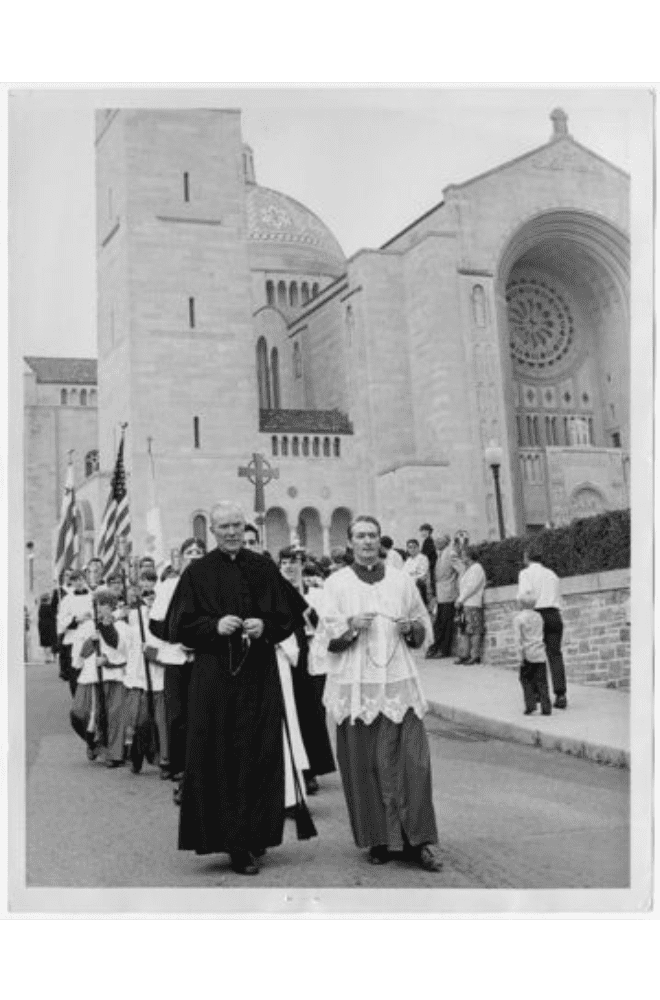
The Dominican Rosary Pilgrimage is hosted by the Dominican Friars of the Province of St. Joseph at the Basilica of the National Shrine of the Immaculate Conception and promotes the Confraternity of the Most Holy Rosary.

This event is supported by the Dominican Foundation of Dominican Friars Province of St. Joseph, Inc. a NY State tax-exempt corporation under section 501(c) (3) of the Internal Revenue Code, with tax ID # 26-3273636.

Privacy Policy | Copyright ©2025 Dominican Rosary Pilgrimage
Designed by Fuzati

Primary Logo Color

"*" indicates required fields

¿Planea asistir a la Peregrinación en persona?*
Ingrese un número del 0 al 2000.

Primary Logo Color

"*" indicates required fields

Name*
Are you a member of your parish or ministry's leadership team?*