• Skip to main content
SIGN UP
  • News
  • FAQ
  • Schedule
  • Shop
  • Donate
SIGN UP

Dominican Rosary Pilgrimage

A National Pilgrimage Devoted to Christ and Our Lady

  • News
  • FAQ
  • Schedule
  • Shop
  • Donate

Dominican Friars

Mar 13 2026

Ite Ad Joseph

Ite Ad Joseph. “Go to Joseph.”

These were the words of Pharaoh to the people of Egypt during the years of famine (Gen 41:55). These are the words inscribed at the base of the statue of St. Joseph in front of St. Joseph’s Oratory of Mount Royal. This Oratory was founded by St. André Bessette, who obtained many miraculous healings through the intercession of St. Joseph.

By declaring St. Joseph, the husband of Mary, the universal patron of the Catholic Church, the Catholic Church tells us to go to St. Joseph in our times of need as well. We can draw much spiritual fruit from considering the first Joseph, the son of Israel, as a type of Joseph, the husband of Mary. Psalm 105 below summarizes nicely the important facts of the ancient Joseph’s life:

When [the Lord] summoned famine against the land,
       and broke every staff of bread,
he had sent a man ahead of them,
       Joseph, who was sold as a slave.
His feet were hurt with fetters,
      his neck was put in a collar of iron;
until what he had said came to pass,
       the word of the Lord kept testing him.
The king sent and released him;
       the ruler of the peoples set him free.
He made him lord of his house,
       and ruler of all his possessions,
to instruct his officials at his pleasure,
       and to teach his elders wisdom. (Ps 105:16-22)

The first part of the above passage describes a land beset by famine. In the times of Joseph of the Old Testament, people everywhere lacked food, but God provided for them through Joseph. In the Gospels, Jesus Christ is born as an infant who needs to be fed, and just as the people of Egypt sought food from Joseph, the head minister of Pharaoh’s household, so Jesus goes to Joseph, whom God has set over his own household, to receive the necessities of earthly life.

The description of Joseph bound in fetters and an iron collar is evocative of the bonds of sin. However, it has long been the tradition of the Church that St. Joseph, the husband of Mary, never committed a single actual sin; however, unlike Mary he was not immaculately conceived, and he came into being with the fetters of original sin. Yet, just as the king released Joseph, the son of Israel, from his bonds and set him over his household, so also God released Joseph, the husband of Mary, from his bonds of sin and set him over the Holy Family as its head.

And just as through Joseph, the son of Israel, God provided food for the starving people of Egypt and his family, so through Joseph, the husband of Mary, did God the Father provide for the needs of Jesus. In formation houses of the Dominican province of St. Joseph, there is a tradition of singing an antiphon at dinnertime that honors St. Joseph: Ecce fidelis servus et prudens, quem constituit Dominus super familiam suam. It translates to “Behold! A faithful and prudent servant, whom the Lord placed over His household.” This antiphon reminds us of the trust which God placed in St. Joseph to manage His household. Further, since it is prayed at dinner, it reminds us that Joseph, by his prayers, obtains for us those good things we need, such as the food we’ve just eaten. For just as St. Joseph watched over and cared for Mary, St. Joseph similarly watches over and cares for the Church, whom Mary represents, and all Christians belonging to it. If God the Father was pleased to provide for His Son, Jesus, through St. Joseph, then we can be confident that if we turn to St. Joseph as God’s faithful steward we will not lack for anything. In times of distress, go to Joseph.

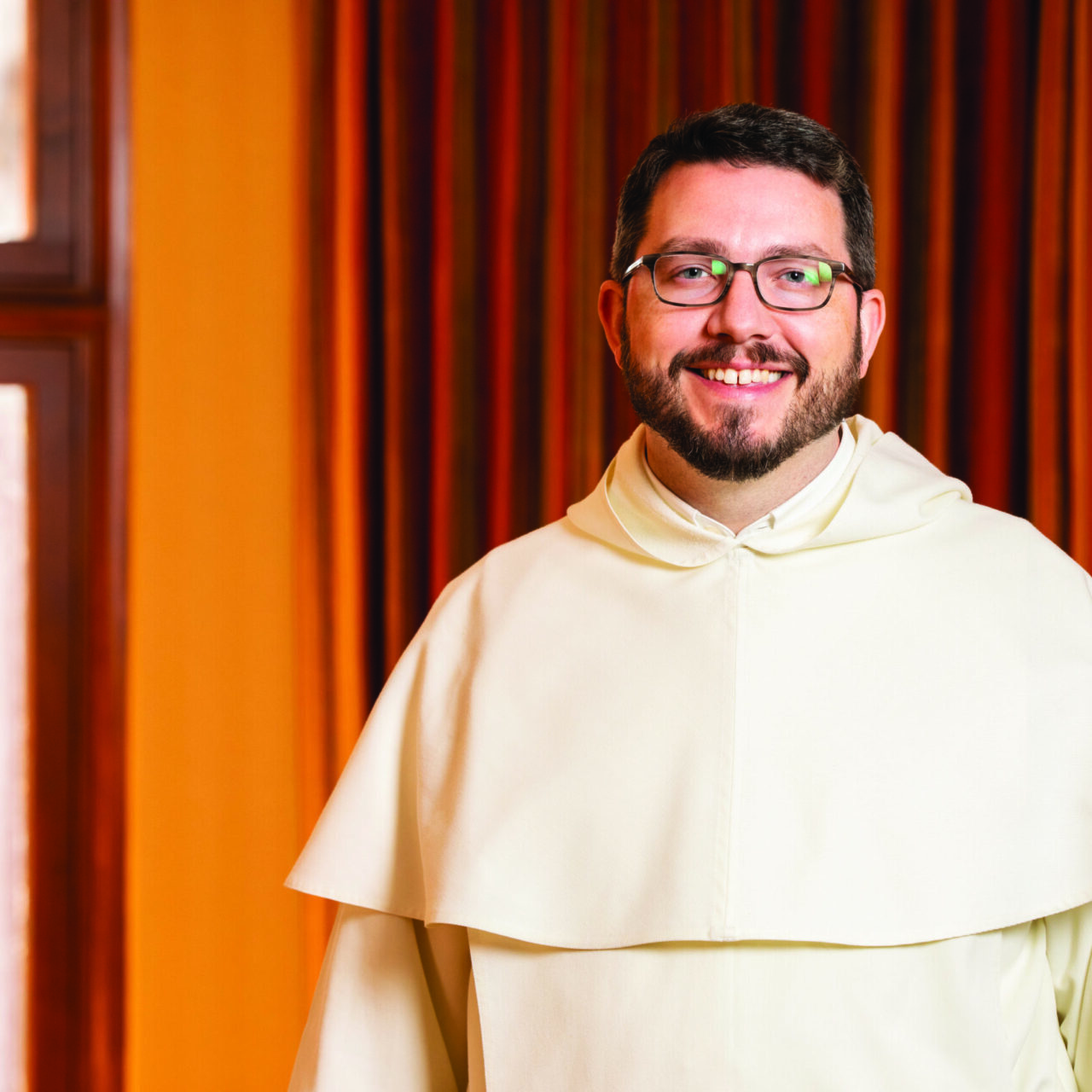
This article was originally published in dominicanajournal.org and was written by Fr. Bartholomew Calvano, O.P.
Written by Dominican Friars · Categorized: Uncategorized

Mar 09 2026

St. Patrick’s Slavery

Similar to the Irish people, St. Patrick moved from slavery to slavery. Looking at the life of today’s celebrated saint, we see three modes of slavery which are emblematic of the people he helped save. St. Patrick and his flock have been slaves to humans, sin, and Christ. The life of Patrick shows us the healing and freeing power of grace which removed the yoke of man and sin and replaced them with the sweet yoke of Christ.

The opening words of St. Patrick’s most famous work, Confessio, read:

I, Patrick, a sinner, very rustic, and the least of all the faithful, and very contemptible in the estimation of most men, had as father a certain man called Calpornius…who was in the town Bannaventa Berniae…where I conceded capture.

St. Patrick was the son of a deacon and grandson of a priest—priestly celibacy wasn’t unanimous in the 4th century. Despite his family’s religion, Patrick accused himself of ignorance of God and of committing some grave sin which he never named. He blamed himself for his eventual capture and enslavement as he was shipped off to Ireland. As a slave, Patrick became a figure of solidarity for the Irish people, because the Irish have often suffered human oppression.

During the 17th and 18th centuries, many Irish entered into indentured servitude in order to find passage to America. One should not equate or conflate this type of slavery with the chattel slavery coming from Africa; St. Patrick escaped the latter. In lieu of their status as indentured servants, many Irish (among other poor Europeans) labored under the yoke of another human. Similarly, Irish immigrants during the Industrial Revolution met inhospitable conditions in their apartments and factories. While laboring under harsh demands, many Irish prayed to St. Patrick—a man who spent six years in slavery.

Patrick learned to pray to the Father in secret while he endured injustice. The Father gradually freed him from his sin and ignorance while he endured “hunger and nakedness daily.” Those six years of slavery helped him mature from his rambunctious youth. Patrick grew in love and fear of the Lord while learning Christian humility:

Whoever would be great among you must be your servant, and whoever would be first among you must be your slave. (Mt 20:26–27)

After learning humility in the midst of oppression, St. Patrick confessed the mercy God showed him:

The Lord turned His gaze round on my lowliness and took pity on my adolescence and ignorance and kept watch over me before I knew Him…He fortified me and consoled me as a father consoles a son.

Eventually, the Lord visited Patrick in a mystical way and guided him out of captivity and Ireland. Patrick’s emancipation from slavery and sin encapsulates St. Paul’s words, “So through God you are no longer a slave but a son” (Gal 4:7). He rejoiced in the “glorious liberty of the children of God” (Rm 8:21). The saint praised the Lord for his liberation from man, but he praised God more for the grace that freed him from ignorance and sin. St. Paul’s words describe well Patrick’s conversion:

But thanks be to God, that you who were once slaves of sin have become obedient from the heart to the standard of teaching to which you were committed, and, having been set free from sin, have become slaves of righteousness. (Rm 6:17–18)

Patrick was freed from two forms of slavery in order to become a slave of righteousness. Yet, this slavery is different, because it is tied to sonship and friendship. “No longer do I call you servants…but I have called you friends” (Jn 15:15). It is a paradox that one can be the son of God and a friend of Christ, and find freedom in obedience. Patrick’s life testifies to that truth, as he obeyed the Lord’s call and returned to the land of his captivity.

Patrick records a locution of the Irish people calling to him, “We call you, holy boy, that you come and walk farther among us.” Whereas before the Irish forced Patrick to the yoke of human slavery, here they beckon him to take on the yoke of Christ. The impassioned call helped create one of the greatest evangelizers in Church history and helped produce an emerald isle of the faith.

Today, merrymaking and lamentation seem a fitting response to Ireland’s patronal feast day. It’s a day of Masses, prayers, dancing, and, unfortunately, riotous drinking. The latter debauchery flies in the face of St. Patrick’s sanctity; indeed, the green-clad souls pounding green Guinness manifest the pagan world the saint brazenly entered. St. Patrick, a man freed from a twofold slavery, took on the yoke of Christ to liberate such as these still captive to sin. We can even now learn from his words:

I had come to Irish gentiles to proclaim the Gospel, and to endure indignities from unbelievers…so that I might give up my freeborn status for the advantage of others…for His name.


This article was originally published in dominicanajournal.org and was written by Fr. Irenaeus Dunlevy, O.P.

Written by Dominican Friars · Categorized: Uncategorized

Feb 11 2026

The Virtues of Lent

Jesus describes the righteousness one needs in order to reach the kingdom of heaven, noting that it must surpass that of the scribes and Pharisees (Matt 5:20–24). He discusses the relationship one should have with one’s brother, saying that there is much more to it than simply observing the Old Testament commandment not to kill. It is wrong even to be angry with one’s brother or to call him a fool. Furthermore, Jesus advises us that if we are not at peace with our brother we should make peace with him before offering gifts to God.

In this teaching, Christ describes both justice and the interior dispositions that go even further in making one righteous. The cardinal virtue of justice, as St. Thomas Aquinas defines it, is the “habit whereby a man renders to each one his due by a constant and perpetual will.” From this, we can draw out two of the chief characteristics of justice. The first is that it is concerned with other persons. It’s about giving to one distinct from oneself what he or she deserves. Secondly, justice is objective. It is primarily about the thing that is owed. It is not about what the other wants to receive or what you want to give. The commandment “Thou shalt not kill” regards justice, then, in its most proper form. It is a matter of showing due respect for the life God has given to the other man. Jesus gives other examples of unjust behavior to avoid. One owes respect not just to the life of the other but to his dignity as man as well, and so one ought not to disdain him by slandering or committing detraction against him. Christ goes even further than justice properly speaking (i.e., our outward actions) and addresses what can be called justice analogously. That is, He describes how to “be right” with oneself, and this is by overcoming one’s passions, such as anger.

If this Gospel passage talks about establishing a just relation with our brother, what about our relationship with God? We might be tempted to think that Lent is about merely establishing a just relationship between ourselves and Him. Perhaps, for example, we think of the penances we undertake simply as a way of “repaying” God for dying on the Cross for us. It does indeed fall within the scope of justice to offer prayers and sacrifices to God, since we owe all we have and even our very existence to Him.  We can never really repay God fully, though, either for that existence or for the redemption He worked for us. So we can never have a truly just relationship with Him in that sense.

Lent is not about evening things out with God. Since our prayers and sacrifices add nothing to God’s greatness or happiness, they are not primarily for His benefit, but rather for our own. Lent helps us recognize what we owe God, but even beyond that it is about preparing for the celebration of Christ’s supreme act of charity in suffering His Passion and death for our salvation. The prayer and penances are a means to our growth in charity, which is achieved when obstacles between ourselves and God are removed. As Jesus notes in the Gospel, one of those obstacles often is a lack of peace with our brother. For, “he who does not love his brother whom he has seen, cannot love God whom he has not seen” (1 Jn 4:20). This Lent, may the charity of the Just Man fill us with longing for the kingdom of heaven and inspire us to imitate Him.

This article was originally published in dominicanajournal.org and was written by Fr. Joachim Kenney, O.P.

Written by Dominican Friars · Categorized: Uncategorized

Dec 29 2025

Join Us for the 2026 Novena & Dominican Rosary Pilgrimage

We invite you to mark your calendar for the Dominican Rosary Pilgrimage 2026, taking place in on September 26, 2026, at the Basilica of the National Shrine of the Immaculate Conception in Washington, D.C.

Each year, thousands of pilgrims from across the country gather to pray the Rosary together, celebrate the Eucharist, and entrust their intentions to Our Lady—asking to be led more deeply to Christ through her intercession.

A Pilgrimage That Begins in Prayer

The Dominican Rosary Pilgrimage begins long before pilgrims arrive in Washington.

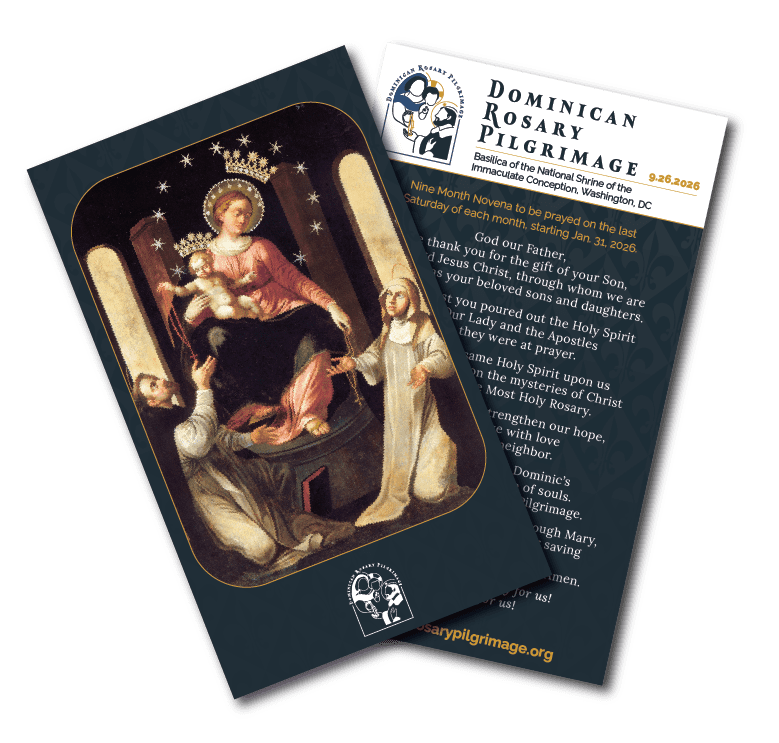
Preparation for the 2026 Dominican Rosary Pilgrimage starts with a nine-month novena, beginning on January 31 and prayed on the last Saturday of each month, continuing until the pilgrimage itself. Through this sustained rhythm of prayer, families, parishes, and communities are united in asking Our Lady to draw hearts more deeply to Christ.

You may request a novena prayer card to be mailed to you at no cost, or download the prayer card to pray along digitally.

Are you a ministry leader and pastor? You can request novena cards in bulk to share with you communities here.

2026 card mockup
DOWNLOAD CARD

MAIL ME A CARD

Join Us — and Invite Others

There are many ways to take part:

  • Attend as an individual pilgrim or with a group
  • Invite family members, friends, parishioners, pastors, and ministry leaders
  • Share the invitation with those seeking deeper prayer and renewed devotion to the Rosary

Click here for more information on group and ministry registration.

Stay Connected

Follow @DominicanRosary on social media and return to this page for:

  • Pilgrimage updates
  • Monthly videos and reflections
  • Articles on the Rosary and Dominican spirituality

We look forward to praying with you in Washington, D.C.

Written by Dominican Friars · Categorized: Uncategorized

Dec 16 2025

He Came Down from the Stars: A Christmas Reflection

Many of the Christmas carols familiar to us come from the English and German/Austrian traditions. Think of “Hark! The Herald Angels Sing,” “Joy to the World,” which are traditional English carols; “Silent Night,” and “Lo, How a Rose E’er Blooming,” from the Germanic tradition.

The Italians, on the other hand, do not have a grand repertoire. The most famous, traditional, Italian carol was penned by St. Alphonsus Liguori, the founder of the Redemptorists and the patron saint of moral theologians, in the 1730s, and is entitled “Tu scendi dalle stelle,” “O You who Come Down from the Stars.”

Like so many Christmas carols, Liguori’s song sets the scene of the Nativity in the darkness and cold of winter: “You come down from the stars, / O King of Heaven. / And settle in a cave of cold and ice.” Into this concrete picture, the mystery at hand is also named: “O Bambino, mio Divino,” “O little baby, my Divine one.” The child of Bethlehem, shivering in the cold, is none other than God himself.

And like the best carols, the emotions of the moment are also highlighted: “When I see you there shivering, / O how much did it cost you to love me!” The affective response of any human being to a tiny baby, cold and in a cave, is one of compassion, but here, the believer is led to amazement at the love of God Incarnate, shivering in the cold, as a sign of the love God has for his Creation in sending his Son.

Over the centuries, the Christian imagination has generated countless forms of contemplative exercises to allow the mind and heart of the believer to enter into the mysteries of the Faith, not merely as abstractions, but in concrete, historical moments wherein the eternal God reveals himself.

The mystery of the Incarnation, celebrated at Christmas, but meditated upon continually throughout the year in the Joyful Mysteries of the Rosary, comes alive in these contemplative moments given to us by the Christian imagination. In them, we see that the point of the Christian life is not just doing good and avoiding evil; it is not just making sure to follow the rules, and to do “Catholic things.” It is, rather, to allow the life of God, the God whose infinity was dwindled to infancy in the Bambino of Bethlehem, to become our life.

In order to make this possible, the eternal and all-powerful God takes on the humility and poverty of his Creation, to bring it into maturity and the richness of eternal life. The Italian carol’s last verse speaks of Christ as the “Caro eletto pargoletto,” that is, the “dear and chosen kiddo.” That is, the Eternal Son, who sits at the right hand of the Father in majesty, becomes a rugrat. It goes on to exclaim: “How this, your poverty, makes me love you even more, / since love has made you still poorer.” In the Incarnation, Christ loses nothing of who and what he is as God, but he takes on our human nature, lowering himself to his Creation.

As St. Paul writes to the Corinthians: “though he was rich, yet for your sake he became poor, so that by his poverty you might become rich” (2 Cor. 8:9). The poverty of Christ, so beautifully sung by this carol, has its goal not just the manifestation of God’s love for us, but that, as God takes on our human nature in the Incarnation, we might come to take on his nature in the Redemption. The liturgy of the Christmas season often speaks of the “wonderful exchange” that happens when God becomes man so that man might become divine. We might better speak of it as the “wonderful bargain”: God takes on our limited and sinful humanity and we get his eternal and divine life.

Our celebration of Christmas, and our meditation on the Incarnation throughout the year in the recitation of the Rosary, then, are moments where we experience the historical reality of the one who “came down from the stars” to manifest his love for us in his poverty. Our hope is that by allowing this reality to take over our minds and hearts, we might, in the company of the Virgin Mary, allow there to be, as the poet Gerard Manley Hopkins wrote, 

New Nazareths in us, Where she shall yet conceive Him, morning, noon, and eve; New Bethlems, and he born There, evening, noon, and morn.


Catholic Studies Faculty and Staff Photo Shoot part 2

Written by Fr. Austin Litke, O.P.
Fr. Austin was the principal preacher at the 2025 Dominican Rosary Pilgrimage. He was ordained a priest in 2011 and has served as chaplain to patients at Sloan Kettering Memorial Cancer Hospital in New York city as well as to students at New York University. He earned a doctorate in Patristic Theology from the Pontifical Patristics Institute of the Lateran University in Rome and has taught at the Pontifical University of St. Thomas (the Angelicum) in Rome as well as the Dominican House of Studies in Washington, DC. He is currently a professor in the Department of Catholic Studies at the University of St. Thomas in St. Paul, Minnesota. This Fall, he will move to Rome to teach at the Angelicum. Fr. Austin is a member of the Hillbilly Thomists.

Written by Dominican Friars · Categorized: Uncategorized

  • « Go to Previous Page
  • Page 1
  • Interim pages omitted …
  • Page 3
  • Page 4
  • Page 5
  • Page 6
  • Page 7
  • Interim pages omitted …
  • Page 27
  • Go to Next Page »

Contact Us:

Dominican Rosary Pilgrimage
141 East 65th Street
New York, NY 10065

Tel: (212) 744-2410
info@rosarypilgrimage.org

Media Inquiries: Kevin Wandra
Tel: (404) 788-1276
KWandra@
CarmelCommunications.com
PRESS RESOURCES
The Dominican Rosary Pilgrimage is hosted by the Dominican Friars of the Province of St. Joseph at the Basilica of the National Shrine of the Immaculate Conception and promotes the Confraternity of the Most Holy Rosary.

This event is supported by the Dominican Foundation of Dominican Friars Province of St. Joseph, Inc. a NY State tax-exempt corporation under section 501(c) (3) of the Internal Revenue Code, with tax ID # 26-3273636.

Privacy Policy | Copyright ©2026 Dominican Rosary Pilgrimage
Designed by Fuzati

Primary Logo Color

"*" indicates required fields

¿Planea asistir a la Peregrinación en persona?*
Ingrese un número del 0 al 2000.

Primary Logo Color

"*" indicates required fields

Are you planning to attend the Pilgrimage in person?*
Are you a member of your parish or ministry's leadership team?*
Please enter a number from 0 to 2000.